
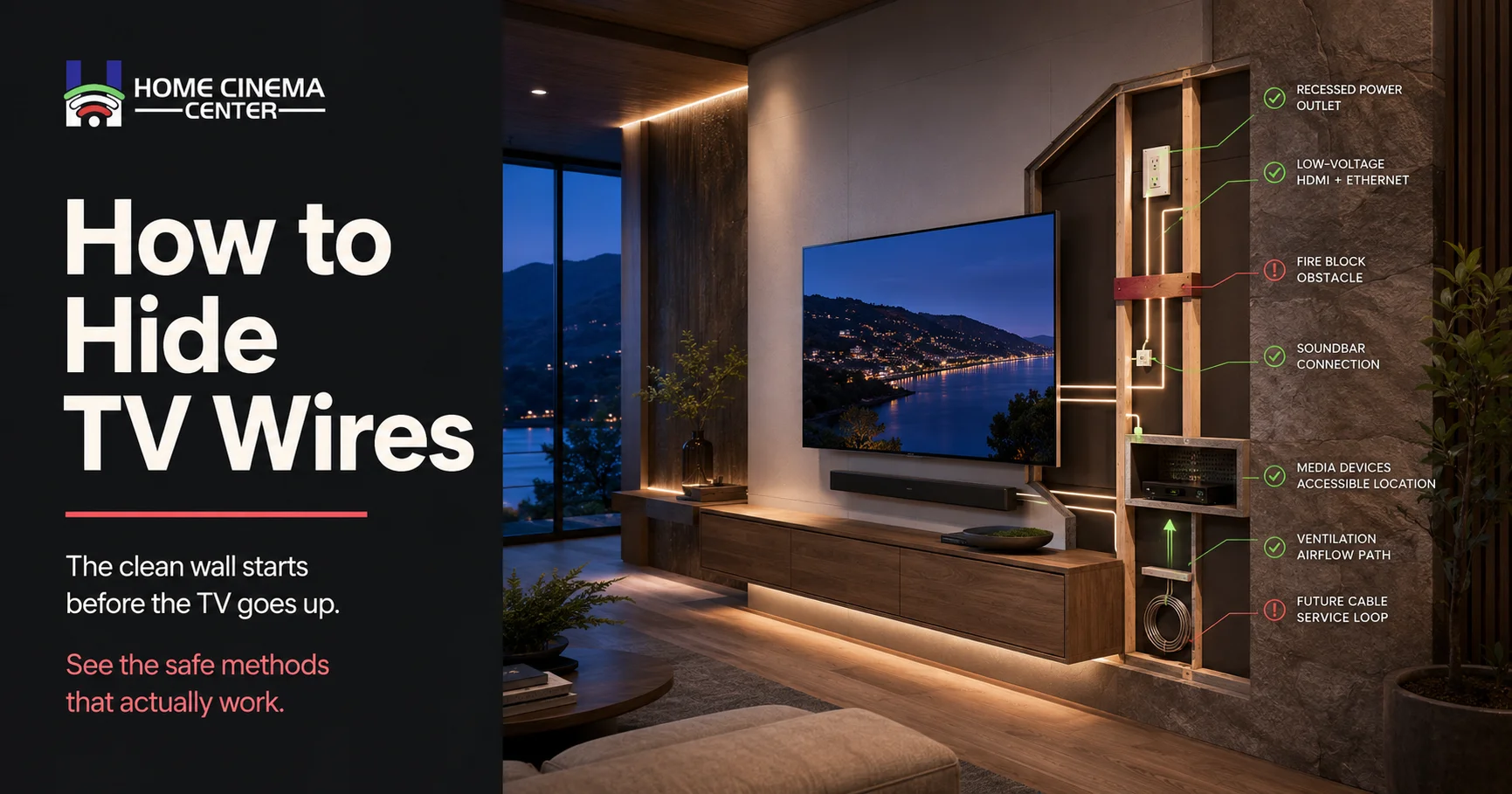
The wall looked finished until the cords showed up.
That is the part nobody puts in the showroom photo. The TV is slim. The mount is solid. The room is beautiful. Then a black power cord drops down the wall, an HDMI cable bends toward the console, and suddenly the “clean install” looks like a temporary setup.
Here is the truth: your TV mount probably is not the problem. The hidden cause is the cable plan.
If you are searching for how to hide wires wall mounted TV, the safest answer is this: use a paintable cable raceway for a quick no-cut fix, use an in-wall cable path for low-voltage cables when the wall allows it, and use a proper recessed outlet or qualified electrician for power. Never treat a standard power cord like an HDMI cable.
Key Takeaways
- A clean TV wall starts before the TV is mounted, not after.
- Cord covers work well for renters and quick fixes.
- In-wall cable management looks cleaner, but the cable type matters.
- Standard power cords and extension cords should not be buried inside walls.
- Fireplaces, soundbars, finished walls, and luxury rooms usually deserve a professional plan.

How to Hide Wires Wall Mounted TV Setups Without Creating a Bigger Problem
The easiest way to hide TV wires is not always the best way. That is where homeowners get burned.
A cord cover may be perfect for an apartment. An in-wall cable management kit may be right for a finished living room. A recessed outlet behind the TV may be the cleanest answer when power is in the wrong place. The right method depends on the wall, the devices, the room, and whether the wire carries power or signal.
Signal cables include HDMI, Ethernet, optical audio, speaker wire, and some low-voltage control cables. Power is different. A TV power cord, extension cord, or power strip should not be pushed into the wall cavity just because it disappears and you don’t see it.
The Electrical Safety Foundation International reports that roughly 3,300 home fires originate in extension cords each year, and it warns against using extension cords as permanent wiring or running them through walls, ceilings, floors, or doorways.
That is the safety line. Hide the mess, yes. Hide the risk, no.

For homeowners who want the clean version done correctly, professional TV installation is often less about “mounting a screen” and more about planning power, routing, service access, sound, network stability, and the final look of the room.
The Hidden Cause: Most TV Walls Are Installed Backwards
Most people start with the TV.
They pick the wall, buy the mount, hang the screen, plug everything in, and then notice the wires. At that point, every solution feels like damage control.
The smarter order is different:
- Decide where the TV should sit.
- Confirm where safe power will come from.
- Plan the cable path.
- Choose where devices will live.
- Mount the screen after the wall plan makes sense.
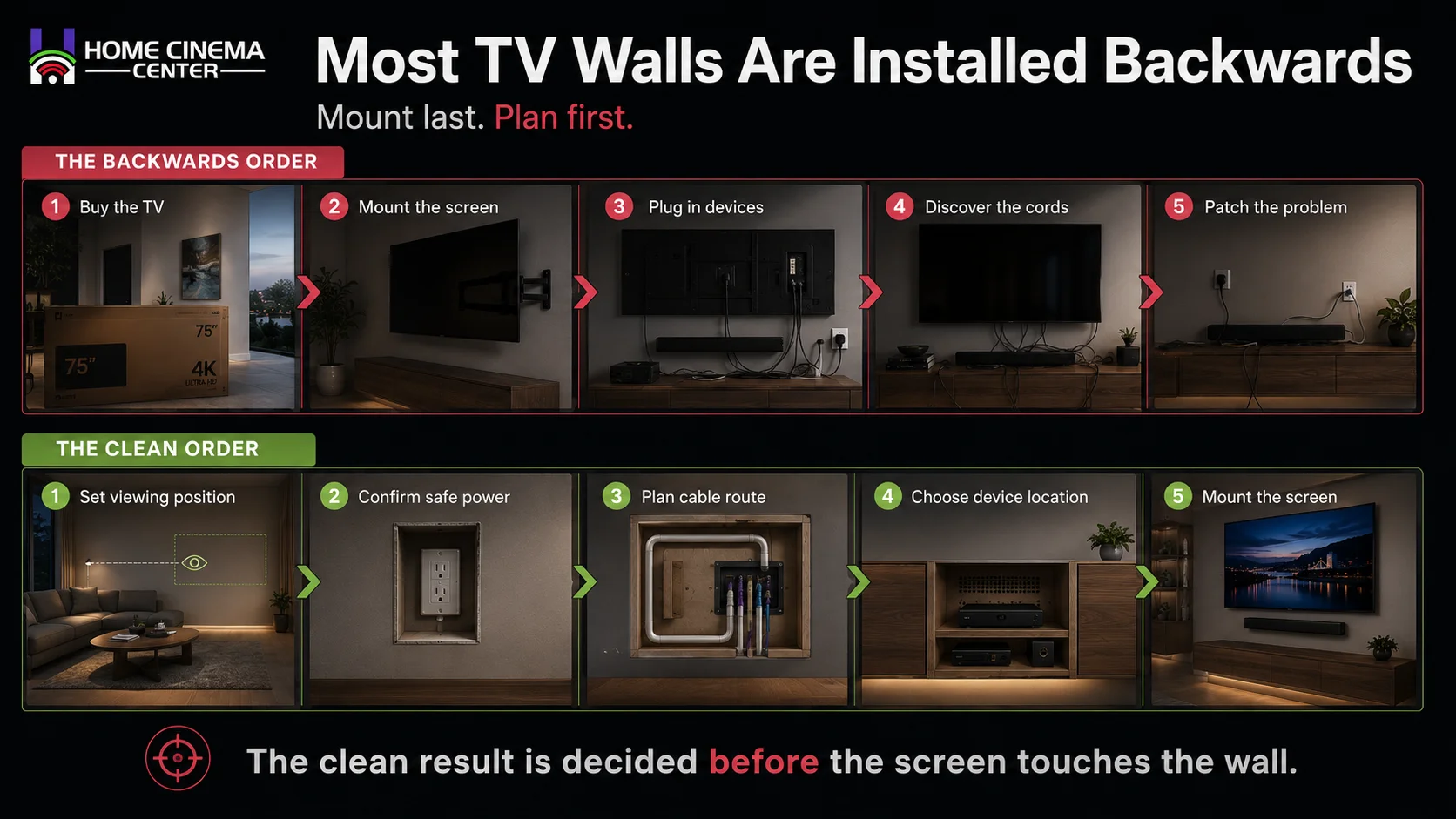
That is why some expensive rooms still feel cheap. The screen may be premium, but the install is working against the room.
A clean TV wall setup is not only about hiding cables. It is about making the TV feel like it belongs there.
Quick Self-Check Before You Buy a TV Cord Hider
Before buying a TV cord hider, look at the wall for two minutes. This quick check can save you from buying the wrong product.
Ask these questions:
- Is this a rental or a home you own?
- Is the wall drywall, brick, stone, concrete, plaster, or above a fireplace?
- Is the outlet behind the TV or below it?
- How many cables need to disappear?
- Are you hiding only HDMI and Ethernet, or also power?
- Will you add a soundbar, streaming device, game console, or speakers later?
- Do you need the setup to be reversible?
If the answer is “I rent,” a surface raceway usually wins.
If the answer is “I own the home and want no visible wires,” an in-wall path or recessed media box may be better.
If the answer is “the power outlet is in the wrong place,” slow down. That is not a cable-management problem. That is an electrical planning problem.
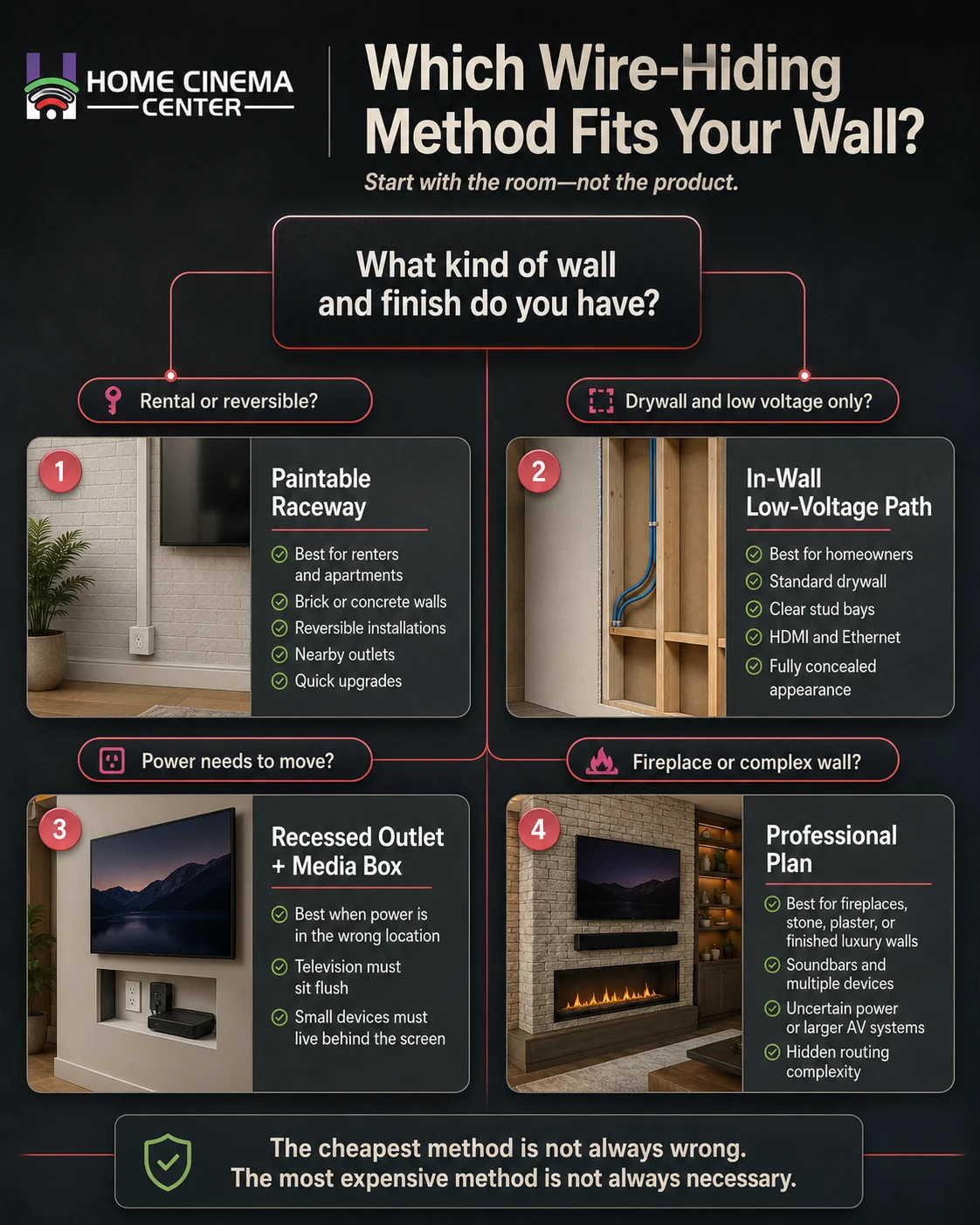
Option 1: Use a Paintable Cable Raceway for TV Wires
A paintable cable raceway is the cleanest no-cut option for hiding TV cords on wall surfaces. It is a slim channel that mounts to the wall and covers the cables between the TV and the outlet or media console.
This is usually the best choice for:
- Renters
- Apartments
- Concrete or brick walls
- Quick upgrades
- Budget-conscious projects
- Rooms where cutting drywall is not worth it
The trick is to make it look intentional. Run it straight. Keep the path short. Paint it the same color as the wall. Use the smallest number of turns possible.
The mistake nobody notices until it is too late? Buying one that is too narrow.
One HDMI cable may fit fine. Then someone adds a soundbar, a streaming box, Ethernet, and a game console. Suddenly the cover will not close, or it bulges off the wall like it is holding a secret.
If the room may grow into a larger entertainment setup later, plan the cable capacity now.
Option 2: Hide TV Wires in Wall for the Cleanest Look
For a more finished result, many homeowners choose to hide TV wires in wall cavities using low-voltage wall plates or an in-wall cable management kit.
This is where the setup starts to look designed instead of patched together.
A common DIY process uses a stud finder, drywall knife, fish tape, tape measure, and low-voltage recessed cable plates. The source material also emphasizes lining up the upper and lower openings vertically, avoiding studs, and routing only data or optical cables through the wall rather than a standard power cable.
That method can work well when the wall is friendly. But real homes are not always friendly.
There may be insulation. Fire blocking. Old wiring. Tight stud bays. Plaster walls. Stone surrounds. A fireplace chase. Or a beautiful finished wall where one bad cut becomes a visible regret.
This is where home theater installation thinking matters. The goal is not simply to make today’s wires disappear. The goal is to make the room work beautifully when the system changes later.
Option 3: Install a Recessed Outlet Behind the TV
A recessed outlet behind the TV is one of the cleanest solutions because the TV plugs in directly behind the screen. No cord drops down the wall. No outlet distracts from the design. No awkward power strip sits on the floor.
This option is best for:
- Homeowners
- Permanent TV locations
- Luxury living rooms
- Slim TV installs
- Floating console setups
- Rooms where visible cords would ruin the design
Here is the important distinction: a recessed outlet is not the same as stuffing a power cord inside a wall.
A recessed outlet is part of the electrical system. A standard TV cord is not. If power needs to move, a licensed electrician may be required depending on the work and local code.
This is the kind of detail that separates a clean installation from a risky shortcut.
Option 4: Use a Low-Voltage Cable Pass-Through
A low-voltage cable pass-through lets HDMI, Ethernet, optical audio, speaker wire, or other approved low-voltage cables travel from behind the TV to a lower wall plate near the console.
It is especially useful when the TV connects to:
- A receiver
- A streaming device
- A game console
- A soundbar
- A network switch
- A media cabinet
For modern homes, cable management and network planning often overlap. If the TV depends on streaming, smart controls, cameras, or music zones, weak connectivity can make the entire setup feel unreliable. That is why home network installation can be part of a better TV wall plan, especially in larger Marin County homes with finished walls, thick materials, or rooms far from the router.
A clean-looking TV that buffers every night is not a clean experience.
Which Wire-Hiding Method Should You Choose?
| Method | Best for | Why it works | What to watch out for |
| Paintable cable raceway | Renters and quick fixes | Hides wires without cutting the wall | Can look bulky if overfilled |
| In-wall cable path | Homeowners who want a clean wall | Keeps low-voltage cables out of sight | Cable type and wall access matter |
| Recessed outlet | Permanent clean power | Removes the visible power drop | May require electrical work |
| Recessed media box | Slim installs with small devices | Hides devices behind the TV | Needs space, ventilation, and access |
| Professional install | Fireplaces, soundbars, luxury rooms | Solves the whole system, not one cord | Costs more than a basic DIY cover |
The cheap answer is not always wrong. The expensive answer is not always necessary.
The right answer is the one that fits the room.
The Fireplace Problem: When “Clean” Gets Complicated
TV above fireplace wires are harder than regular TV wires. The wall may look simple from the outside, but behind it there may be masonry, blocking, a chimney chase, limited space, or heat concerns.
This is where many DIY installs go sideways.
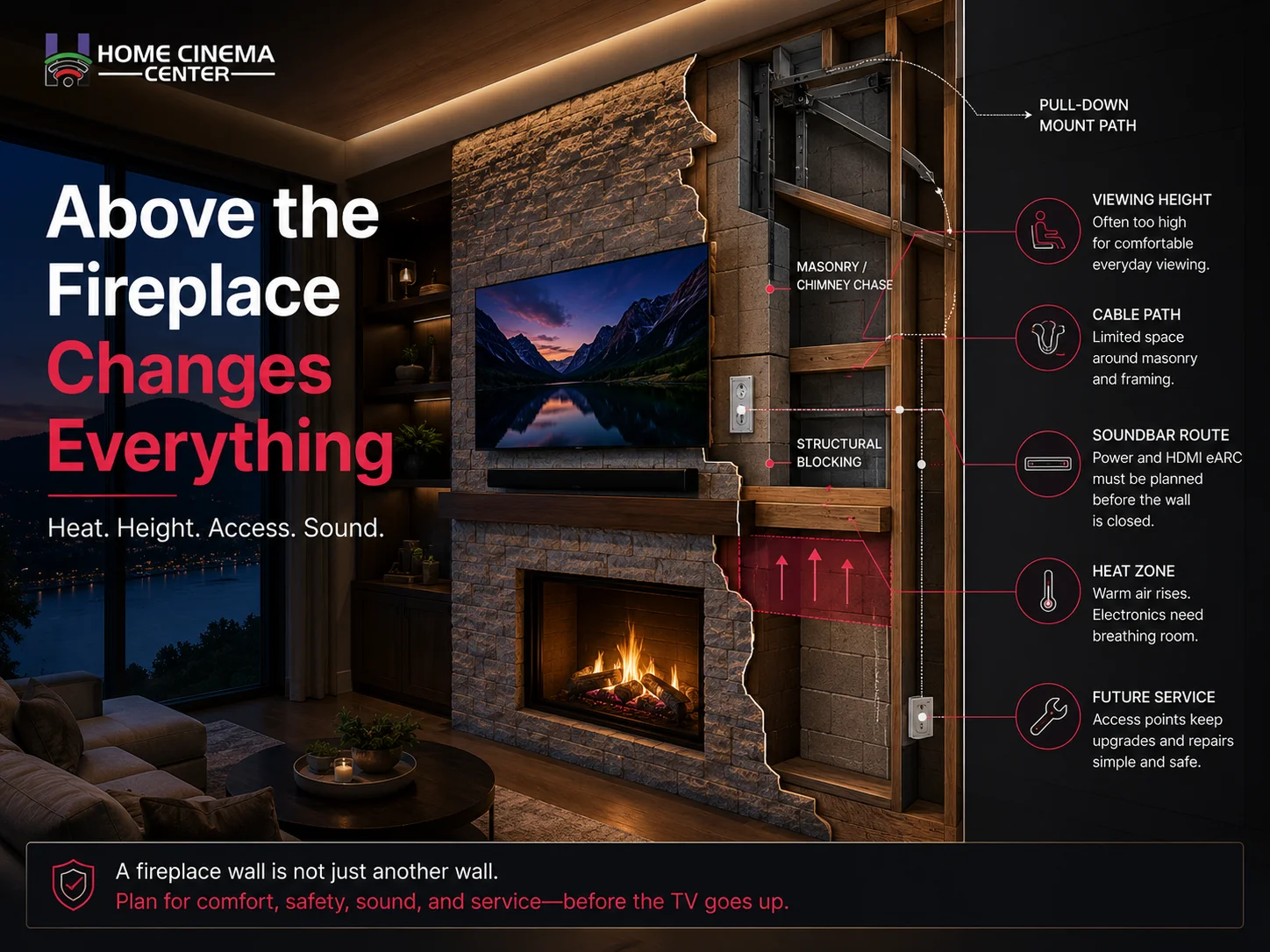
A fireplace TV setup should answer these questions before anyone cuts the wall:
- Is the TV too high for comfortable viewing?
- Is there a safe cable path?
- Will heat affect the TV or wiring?
- Where will the soundbar go?
- Where will the streaming device or receiver live?
- Can the system be serviced later?
A pull-down mounting solution can help when the screen would otherwise sit too high. For rooms where comfort and appearance both matter, Mantel Mount installation can be part of a better plan.
The point is not just hiding wires. The point is avoiding a beautiful mistake.
The Soundbar Mistake Nobody Plans For
A wall-mounted TV with hidden wires can still look messy if the soundbar cable hangs below it.

Soundbar wire hiding should be planned at the same time as the TV mount. The HDMI ARC or eARC cable, optical audio cable, and power location all matter. If the soundbar is mounted below the TV, its cable route should be short, clean, and hidden by design rather than improvised later.
This same thinking applies to in-wall speakers and multi-room audio. If the room is part of a larger entertainment system, Sonos ceiling speaker installation or other integrated audio planning can keep the system from becoming a tangle of visible wires, exposed adapters, and mismatched controls.
A premium room should not need five remotes and a cable trail to play one movie.
What Most People Get Wrong About Wall Mounted TV Cable Management
Most people think the problem is the wire.
It is usually the plan.
Here is the truth-teller version:
- The TV is not messy. The cable path is messy.
- The wall is not the problem. The outlet location may be.
- The soundbar is not the problem. The audio plan may be.
- The streaming device is not the problem. The network may be.
- The expensive screen is not the problem. The room design may be working against it.
This is why “just hide the wires” can turn into a bigger job. A mounted TV connects to power, signal, internet, sound, lighting, furniture, and how people actually sit in the room.
When those pieces are planned together, the TV wall feels calm. When they are not, even expensive gear can feel temporary.
For homes with lighting scenes, music zones, shades, thermostats, and entertainment devices, smart home automation can also reduce the clutter that does not show up in the wires: too many remotes, too many apps, and too many small frustrations.
When DIY Is Enough
DIY can be the right choice when the job is simple.
Use a cord cover or raceway if:
- You rent
- You want a reversible solution
- The outlet is close
- You have only a few cables
- The wall is difficult to open
- You are not moving power
- You are comfortable with a slightly visible cover
Use an in-wall low-voltage path if:
- You own the home
- The wall is standard drywall
- The cable route is clear
- You are using the right in-wall rated cables
- Power is already handled safely
- You can repair drywall if needed
The simple test is this: if the job only hides low-voltage signal cables and the wall is straightforward, DIY may be fine. If the job touches power, fireplace mounting, finished walls, or a larger AV system, a professional plan is usually smarter.
When to Call a Professional
Call a professional when the TV wall needs to look finished, not merely less messy.
That includes:
- TV mounting with hidden wires
- Recessed outlet planning
- Fireplace TV installation
- Soundbar wire hiding
- Home theater cable management
- Hidden media devices
- In-wall speaker wiring
- Network-dependent streaming setups
- Finished walls where mistakes are expensive
- Marin County, Novato, and San Francisco Bay Area homes with tricky room layouts
Local homes often add their own challenges. Older construction, remodeled rooms, hillside properties, thick walls, large living areas, patios, fireplaces, and open floor plans can make “simple” cable hiding less simple.
That is why local experience matters. A clean installation in a Novato family room is not always the same job as a clean installation above a fireplace in Tiburon or a media wall in San Rafael.
The Clean TV Wall Checklist
Before calling the job finished, a proper wall-mounted TV setup should pass this checklist:
- The TV sits at a comfortable viewing height.
- No power cord hangs below the screen.
- Low-voltage cables are routed cleanly and safely.
- The soundbar cable is hidden or minimized.
- Devices are accessible for service.
- The outlet plan is safe.
- The network connection is reliable.
- The wall finish looks intentional from across the room.
- Future upgrades will not require starting over.
If the setup fails two or more of those checks, the issue is probably not the TV. It is the design underneath it.

Conclusion: The Cleanest Wire Is the One Planned Before the Mount Goes Up
A clean TV wall is not created by hiding one cord after the fact. It is created by planning power, signal, sound, devices, network, and room design before the screen becomes the centerpiece.
For a basic apartment, a paintable raceway may be enough. For a polished living room, an in-wall cable path and recessed outlet may be the right move. For fireplaces, soundbars, finished walls, and premium spaces, professional help can prevent the kind of “almost clean” setup that bothers you every time the TV is off.
That is the real answer to how to hide wires wall mounted TV: do not just hide the wires. Fix the hidden cause.

Want the clean version of this setup? Visit Home Cinema Center or request a local consultation. Call 415 897 6217 or 415-892-5509, or email info@homecinemamarin.com.
FAQ
How do you hide wires on a wall mounted TV?
The main options are a paintable cable raceway, an in-wall low-voltage cable path, a recessed outlet, or a recessed media box. The best choice depends on the wall type, outlet location, and whether power needs to move.
Can I run a TV power cord through wall?
No. A standard TV power cord or extension cord should not be run through a wall. Use a proper recessed outlet or ask a licensed electrician when power needs to be relocated.
How do I hide TV wires without cutting wall?
Use a paintable cable raceway, adhesive cord cover, cable sleeve, or furniture placement. This is usually the best renter-friendly option because it is clean, simple, and reversible.
What is the best TV cord hider for wall mounted TV setups?
For most quick fixes, a wide paintable raceway is the most practical choice. For a permanent homeowner setup, an in-wall cable management kit with the right cable ratings usually looks cleaner.
Is TV wire concealment worth it in Marin County homes?
Yes, especially in finished living rooms, remodeled homes, fireplace walls, and open spaces where dangling cords stand out. Clean wire concealment can make the room feel more intentional and less temporary.
How do you hide TV wires above fireplace areas?
A fireplace TV setup may need a custom cable path, safe power plan, heat review, and careful mount selection. This is one of the most common situations where professional help is worth considering.
Can HDMI cable and soundbar wires be hidden together?
Often, yes. The cleaner approach is to plan the TV, soundbar, HDMI ARC or eARC cable, power, and device locations together before mounting anything.
When should you hire someone to hide TV wires?
Hire a professional when the project involves power relocation, a recessed outlet, fireplace mounting, soundbar wiring, finished walls, or a larger home theater system. DIY is fine for simple raceway projects, but not every clean-looking shortcut is safe.


