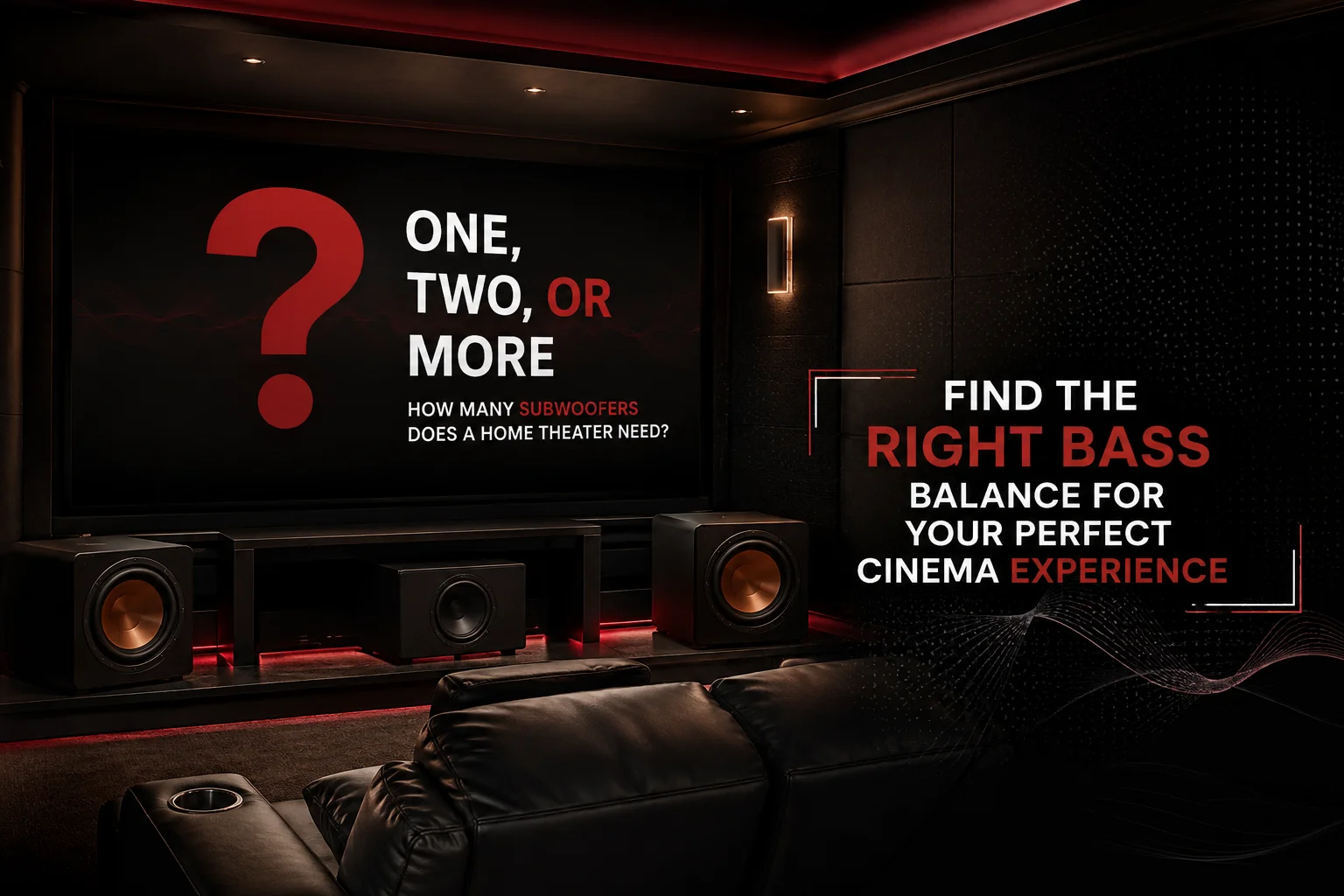
If you have one main seat, one well-placed subwoofer may be enough. If several people sit across a couch or two rows, two subs are often the better answer because they can smooth the big bass changes from seat to seat. Three or four only make sense when the room and calibration plan give them a clear job.
That is the short answer to how many subwoofers do I need.
Here is the part expensive systems often get wrong: stronger bass is not always better bass.
You can spend more on a bigger subwoofer, turn on an action movie, and get incredible impact in the center chair. Then move two seats over and half that bass seems to disappear.
The subwoofer may be working perfectly.
The room is changing what you hear.
That is why Home Cinema Center approaches home theater around the room, speaker positions, equipment, setup, and professional calibration rather than treating every space like the same box-and-speaker package. Its current home theater service specifically includes custom design and professional calibration of speakers, amplifiers, displays, and projectors.
Key Takeaways
- One sub can work beautifully when one listening position matters most.
- Two subs are often about more even bass, not twice as much bass.
- Three or four should solve a measured room problem, not fill empty floor space.
- Placement and calibration can matter more than the logo or price on the cabinet.
How Many Subwoofers Do I Need? Start With the Seats

Do not start with room square footage.
Start with the people.
A small theater with two seating rows can be harder to serve evenly than a larger room with one favorite chair.
Here is a practical starting point:
| Listening setup | Sensible starting point | Why |
| One priority chair | 1 subwoofer | Simple and easier to tune |
| Sofa with several important seats | 1–2 subwoofers | A second can improve consistency |
| Dedicated home theater | 2 subwoofers | Strong balance of output and coverage |
| Large or difficult multi-row theater | 2–4 subwoofers | More control over seat-to-seat bass |
| Engineered high-performance theater | 4+ in some designs | Advanced low-frequency control |
Dolby’s current home theater guidance says a cinematic system should have at least one subwoofer and notes that larger theaters may benefit from multiple units.
But “large room = more subs” is too simple.
Room volume affects how much output you need.
Room shape, speaker placement, and seating positions affect whether that bass arrives evenly.
Those are different problems.
Why Does Bass Sound Great in One Seat and Weak in Another?
Your walls are part of the bass system whether you asked them to be or not.
Low frequencies bounce between walls, floor, and ceiling. Those reflections combine with the original sound.
Sometimes they reinforce each other.
Bass gets louder.
Sometimes they partly cancel.
Bass gets weak.
These patterns are commonly called room modes or standing waves.
That explains one of the strangest home theater experiences: the subwoofer sounds huge on one side of the sofa, but a few feet away the same scene feels much lighter.
Turning up the sub does not fix that
If one seat sits in a bass null, simply raising the volume can make the already-loud seats worse.
You did not fix the distribution.
You only fed more energy into the same pattern.
This is the hidden reason a second subwoofer can improve a system even when the first one already has plenty of power.
The second sub sits somewhere else.
Because it excites the room differently, its response can combine with the first sub in a more useful way.
That is the real multi-subwoofer advantage.
One Subwoofer: When Is It Enough?
One good subwoofer can be the correct answer.
Do not let somebody sell you a pair simply because “serious theaters use two.”
Start with one when:
- One listening seat matters most
- The room gives you useful placement options
- Bass sounds reasonably consistent across the important seats
- The sub has enough clean output for the room
- Floor space is limited
- You want to leave room in the budget for better speakers, processing, or acoustic work
- You plan to add a matching second unit later if measurements show a need
The first placement is rarely sacred
The obvious front corner is convenient.
It is not automatically the best location.
Move the subwoofer through several realistic positions before deciding you need another one.
Listen from the main seat.
Better still, measure the response.
The goal is not to find where the subwoofer produces the biggest boom.
Find where it produces the smoothest useful bass.
One great sub beats two badly integrated subs
Two cabinets do not automatically create a better system.
If they have poor placement, incorrect delay, mismatched levels, or bad phase relationships, they can make bass less predictable.
Hardware count does not replace setup.
Why Can Two Subwoofers Be Better Than One?
Because one subwoofer has one position in the room.
Two give you two.
That simple difference matters enormously at low frequencies.
Each position creates a different pattern of peaks and dips. With thoughtful placement and calibration, one sub can help fill weaknesses created by the other.
The target is not “double the bass.”
The target is less change between seats.
Dirac’s current Bass Control technology is built around this same problem. It analyzes multiple subwoofers and their interaction with the room, then works toward more consistent low-frequency performance across the listening area.
That distinction matters.
If your current complaint is:
“There is not enough deep bass anywhere.”
You may need a more capable subwoofer.
If your complaint is:
“The bass is amazing here and terrible over there.”
A second subwoofer becomes a much more interesting solution.
More Bass vs. Better Bass: Know Which Problem You Have
| What you hear | Likely issue | Smarter first move |
| Bass is weak in every seat | Not enough output, setup, or extension | Check setup or use a more capable sub |
| Bass is huge in one seat and thin in another | Room modes / uneven distribution | Test placement or consider a second sub |
| Bass is boomy almost everywhere | Placement, crossover, room response | Reposition and calibrate |
| Bass sounds detached from speakers | Crossover, delay, phase | Recalibrate integration |
| System sounds clean but runs out of impact | Output/headroom | Larger or additional subs may help |
| Front row sounds good, back row does not | Multi-seat consistency | Multi-sub design becomes more useful |
This is the decision table most buyers need before they start comparing driver sizes.
One Big Subwoofer or Two Smaller Subwoofers?
There is no automatic winner.
One larger sub may give you deeper extension and more output than two smaller models.
Two properly chosen subs may give you better bass distribution across several seats.
Think of the decision this way:
Choose one larger sub when:
Your main problem is output.
You want deeper bass.
One listening area matters most.
You have a good placement location.
You expect to add a second matching unit later.
Choose two capable subs when:
Several seats matter.
Bass changes noticeably across the couch.
You have two useful placement locations.
The processor can integrate them properly.
The budget still allows you to buy subs that are individually capable enough for the room.
Do not sacrifice the basic performance you need just to double the cabinet count.
Two underpowered subwoofers are still underpowered.
Use the SEAT Test Before You Buy Anything
Remember SEAT.
S: Seats
How many people need good bass?
One favorite chair is very different from six seats across two rows.
E: Evenness
Walk across the listening area.
Does the low end change dramatically?
If so, distribution may be the bigger issue.
A: Available Placement
Where can the subwoofers actually go?
Real homes have doors, cabinets, fireplaces, windows, walkways, furniture, and people who do not want a 70-pound black box in the middle of the room.
T: Tuning
Can your receiver, processor, or calibration system manage multiple subs correctly?
Check before buying.
Two outputs on the rear panel do not always mean two fully independent subwoofer channels with separate delay, level, and correction.
That distinction can affect how much control you have during calibration.
Where Should Two Subwoofers Go?
Not automatically beside the left and right front speakers.
That looks tidy and balanced.
Acoustically, it may not give you the full benefit of having two separate bass sources.
Useful starting positions in rectangular rooms can include:
- Front and rear areas
- Midpoints of opposing walls
- Opposite parts of the room
- Other measured locations that create complementary responses
Do not treat those as fixed instructions.
Every real room gets messy.
A rear wall might have a doorway.
One side might open into a hallway.
A fireplace may occupy the location that looks perfect on a drawing.
The better process is:
- Find realistic positions.
- Measure or listen from the important seats.
- Compare the responses.
- Choose locations that work together.
- Calibrate the final pair.
Placement first.
Correction second.
Do Two Subwoofers Need to Match?
When you are buying both from scratch, matching them is usually the cleaner route.
The same model gives you similar:
- Frequency response
- Maximum output
- Cabinet tuning
- Driver behavior
- Amplifier characteristics
That makes level, timing, and phase work easier.
Mismatched subwoofers are not automatically unusable.
Maybe you already own one model that has been discontinued.
Maybe one position requires a smaller cabinet.
A capable installer with measurement tools and independent processing may still get good results.
But mixing random subwoofers because both happen to use a 12-inch driver is not much of a plan.
The driver diameter tells you surprisingly little about how the complete product behaves.
Does a Second Subwoofer Give You More Output Too?
Yes, it can.
Two capable subwoofers sharing the work can provide additional system headroom.
Each unit may not need to work as hard to reach the desired playback level.
That can matter in larger rooms or during demanding low-frequency movie effects.
But keep the priorities straight.
The biggest reason many multi-seat theaters benefit from two subs is not simply extra volume.
It is the chance to improve coverage and consistency while also gaining headroom.
That is a much better reason to spend the money.
When Does a Third Subwoofer Make Sense?
Three is not a bad number.
It is simply less common.
A third sub becomes reasonable when two properly positioned and calibrated units still leave a specific problem.
For example:
- An asymmetric room still has a weak seating area
- Several rows need similar bass
- The system needs more output
- The processor offers useful control over a third sub channel
- Measurements show a placement where the third unit improves the result
The key word is specific.
Do not buy the third subwoofer first and invent its job afterward.
Measure the system with two.
Then decide whether the third unit fixes something worth fixing.
Do You Ever Need Four Subwoofers?
Sometimes.
Four-subwoofer systems make more sense in dedicated theaters where seat-to-seat consistency is a major design target.
They also appear in advanced bass-control systems.
Trinnov’s current WaveForming platform, for example, uses multiple independently driven subwoofers to control low-frequency behavior across one or more listening rows. Its current technical material says WaveForming requires at least four subs in supported configurations.
That does not mean your living room needs four subwoofers.
It shows how far serious bass design has moved beyond “put one big sub in the corner.”
A recent real-world measurement example
A June 29, 2026 Sound Technology article documented one custom theater with four matched subwoofers.
Across five listening positions, the reported bass response varied by less than 3 dB from 20 Hz to 120 Hz after the four-sub setup and calibration. The same room had shown 18 dB of variation with one subwoofer. Read the June 2026 multi-subwoofer measurement example
That is one installation, not a promise that four subs will produce the same numbers in your room.
It does show why serious theater designers measure consistency across seats instead of judging the system from one chair.
Room Correction Helps. It Does Not Make Placement Irrelevant.
Modern room-correction systems are extremely capable.
Dirac Live Bass Control can model subwoofers together with the main speakers, work on timing and phase, manage multiple subs, and target more consistent bass across listening positions.
Still, software does not erase basic acoustics.
If you start with poor subwoofer locations, the correction system gets a harder job.
A deep acoustic cancellation is especially troublesome because simply boosting that frequency wastes amplifier power and driver travel while the room continues cancelling much of the added energy.
Better order:
Placement → alignment → measurement → correction → listening check.
Not:
Bad placement → giant EQ boost → hope.
The Most Overlooked Part of an Expensive Theater Is Often the Room
This fits the Home Cinema Center brand almost perfectly.
People naturally shop the visible equipment.
Bigger screen.
Better speakers.
More powerful subwoofer.
New receiver.
But the room decides what much of that equipment sounds like after installation.
Dirac CEO Anders Storm put it plainly in June 2026:
“the space is consistently the most overlooked of the three”
He was referring to the system, source, and space that make up the complete audio experience. Read Dirac’s June 2026 announcement
That is why buying another premium sub without understanding the room can become an expensive way to keep the same problem.
Quick Self-Check: Do You Need Another Subwoofer?
Before spending money, play a few movie scenes or music tracks with bass you know well.
Then move through every important seat.
Ask:
- Does the bass disappear in some seats?
- Does one side of the sofa sound much heavier?
- Does one frequency boom while another seems missing?
- Is bass weak everywhere?
- Does the system run out of impact only at louder levels?
- Does the sub sound like a separate box instead of part of the speakers?
If the bass is weak everywhere, think output, setup, or subwoofer capability.
If the bass changes dramatically by seat, think placement and multi-subwoofer distribution.
That one distinction can stop you from buying the wrong upgrade.
What Most People Get Wrong About Dual Subwoofers
“Two Subs Means Twice the Bass”
Not really.
More available output can be part of the benefit, but smoother response across the room is often the bigger reason.
Do this: use the second sub to improve the system.
Not that: buy it just to make the loudest seat louder.
“Both Subs Should Sit at the Front Because It Looks Better”
Visual symmetry is not the same as acoustic performance.
Different bass-source locations are often what make the second sub useful.
“Room Correction Will Find the Perfect Setup for Me”
Correction can do a great deal.
It still benefits from good physical placement.
“My Room Is Large, So I Need Four”
Room volume helps determine output requirements.
It does not tell you the ideal subwoofer count by itself.
“If One $2,000 Sub Is Good, a $4,000 Sub Must Fix the Problem”
Only if the problem is subwoofer capability.
A more expensive cabinet cannot move itself into two acoustic locations.
An Illustrative Example: The Six-Seat Theater
Picture a dedicated theater with two rows and six seats.
One powerful sub sits at the front.
The center chair sounds fantastic.
Move to the end of the front row and one bass note becomes much louder.
Move to the back row and another range loses impact.
The owner decides the subwoofer is not good enough.
So they replace it with a larger model in the same location.
Now the center seat has even more bass.
The differences between seats remain.
The upgrade solved the wrong problem.
Now take the original capable subwoofer and add a matching second unit in another measured location.
Align the pair.
Set levels and timing.
Calibrate across the listening area.
The goal is not to make the best seat more dramatic.
The goal is to make all six seats less different.
That is what a properly designed dual-subwoofer system is trying to achieve.
When Is DIY Enough?
A single-subwoofer setup is relatively approachable when:
- The room is simple
- One listening position matters most
- You have several places where the sub can sit
- Your receiver has a good automated calibration routine
- You are comfortable testing different placements
Two or more subs add another layer.
Now you are dealing with the relationship between:
- Each subwoofer and the room
- Each subwoofer and the other subs
- The subwoofer system and the main speakers
- Different listening positions
- Crossover
- Level
- Delay
- Phase
- Equalization
That is where measurement becomes much more valuable than guessing.
When to Call Home Cinema Center
Professional help starts making more sense when the theater has several important seats, dual or multiple subwoofers, a difficult room, high playback expectations, or an expensive system that still sounds inconsistent.
Home Cinema Center’s custom home theater service includes system design, speaker placement, equipment setup, wiring, and professional calibration. The company serves Novato, Marin County, and surrounding North Bay communities.
The useful question for a professional is not:
“How many subs can I fit?”
It is:
“What bass problem does this room need us to solve?”
What About Home Theaters in Marin County and Novato?
The physics are the same in Novato as anywhere else.
The rooms are not.
A dedicated rectangular theater can give an installer several controlled placement options.
A Marin living room with a fireplace, open hallway, glass, built-in cabinetry, and one acceptable place for a sub creates a very different design problem.
A remodel may limit wiring.
New construction may let you prewire multiple subwoofer locations before drywall goes up.
A two-row theater needs broader consistency than a media room where two people always sit in the same place.
That is why Home Cinema Center designs theater systems around the space and budget and provides professional calibration rather than using one fixed package for every room.
Final Thoughts: Better Bass Is Not the Same as More Bass
So, how many subwoofers do I need?
Choose one when one main listening position matters and you can get clean, even bass from a good placement.
Choose two when multiple seats matter, bass changes across the couch, or you want both better consistency and additional headroom.
Consider three or four when measurements, seating, output needs, and the processor give those extra subs a clear purpose.
Do not count cabinets first.
Listen to the problem first.
If one capable sub already gives every important seat deep, controlled bass, buying another unit just because dual subs look serious is unnecessary.
If your expensive sub sounds incredible in one chair and strangely weak three feet away, replacing it with an even more expensive single sub may be solving the wrong problem.
Sometimes the best bass upgrade is not a bigger subwoofer.
It is finally designing the bass around the room.

For a room-specific plan, contact Home Cinema Center in Novato for a home theater design and calibration consultation.
Frequently Asked Questions
How many subwoofers do I need for a small home theater?
One capable subwoofer may be enough for a small home theater, especially when one seat matters most. A second becomes more useful when bass changes noticeably across several seats. Room shape, seating position, available placement, and required output tell you more than square footage alone.
Is one subwoofer enough for home theater?
Yes. One properly sized, positioned, and calibrated subwoofer can deliver excellent home theater bass. Dolby currently recommends at least one for a cinematic system. The main limitation appears when one physical subwoofer position produces very different bass response at different seats.
Are two subwoofers better than one?
Two well-positioned and calibrated subwoofers can be better when several seats need consistent bass. Their different room positions can produce complementary low-frequency responses, which may reduce large seat-to-seat differences. Two badly positioned or badly aligned subs are not automatically better than one properly installed subwoofer.
Do two subwoofers need to match?
Matching models are usually the easier choice when buying a pair from scratch. They have similar output limits, frequency response, cabinet behavior, and amplification, which reduces variables during setup. Different models can sometimes work together, but proper measurement and independent control become more important.
Where should I put two subwoofers in a home theater?
There is no single placement that wins in every room. Opposing walls, front-and-rear locations, and other separated positions can make useful starting points. The best locations depend on room dimensions, openings, furniture, seating, and actual measurements across the positions you care about.
Is one large subwoofer better than two smaller subwoofers?
One larger sub may be better when your main need is deeper extension or higher output. Two capable smaller subs may be better when your main problem is uneven bass across several seats. Compare what each option can reproduce, where the cabinets can sit, and what problem you need to fix.
Do I need three subwoofers?
Most rooms do not need three by default. A third subwoofer makes sense when two properly placed and calibrated subs still leave a measurable coverage or output problem and your processor can manage another subwoofer effectively. Give the third sub a clear job before buying it.
Do I need four subwoofers?
Four subwoofers are usually reserved for more demanding dedicated theaters or advanced bass-control designs. They can give a designer more control over low-frequency response across several seats, but placement, processing, room layout, and calibration determine whether the added hardware provides enough benefit.
Can room correction replace a second subwoofer?
Room correction cannot fully replace the acoustic benefit of placing bass sources in different parts of the room. Software can adjust timing, phase, levels, crossover behavior, and frequency response, but good physical placement and DSP work best together rather than treating one as a substitute for the other.
Can Home Cinema Center help decide how many subwoofers I need?
Yes. Home Cinema Center provides custom home theater design and professional calibration in Novato, Marin County, and surrounding communities. A room-specific assessment can look at seating, bass response, speaker layout, placement options, and equipment before deciding whether one sub, a matched pair, or a larger multi-sub system makes sense.