
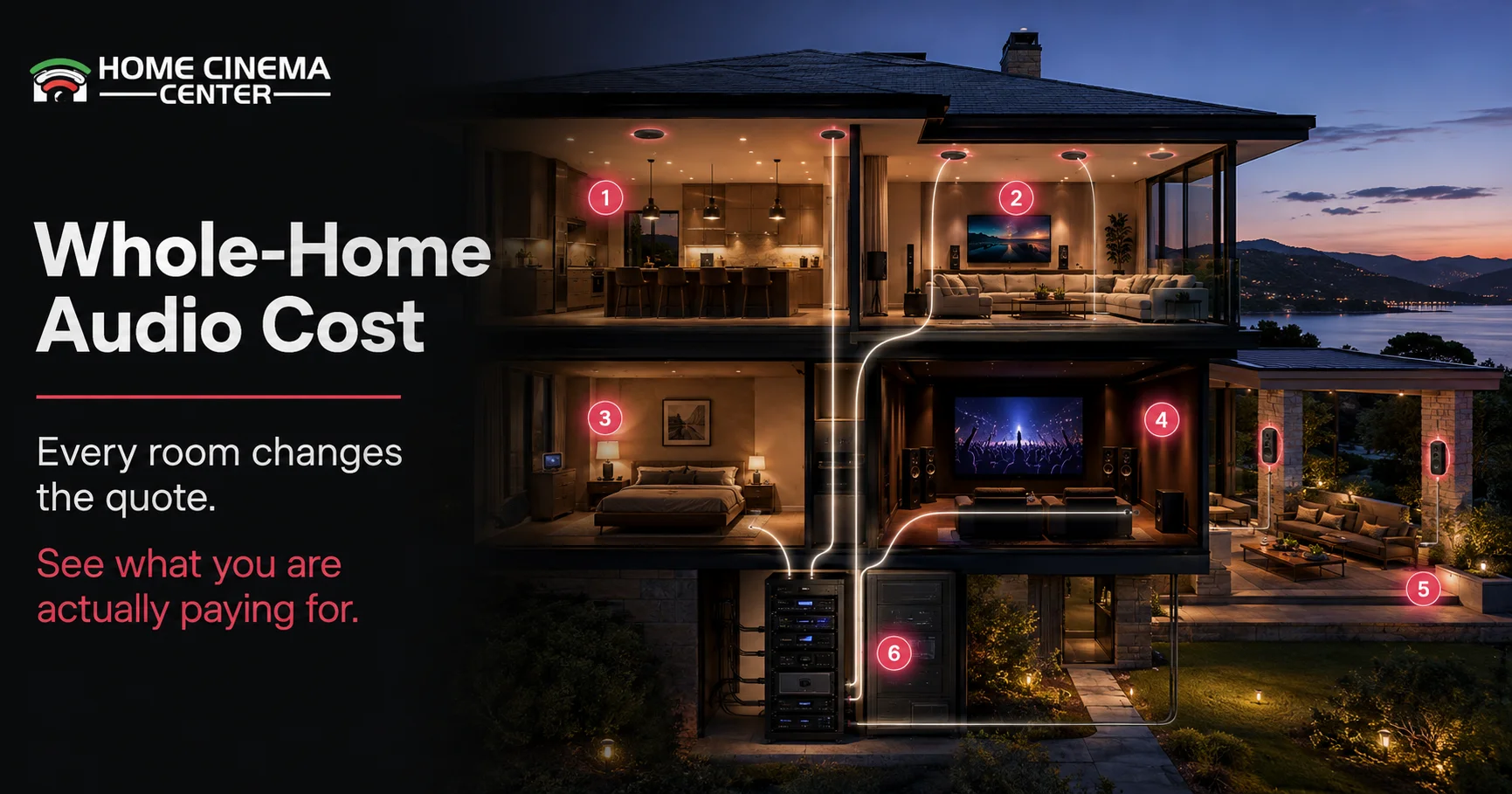
A clear, honest breakdown of whole home audio installation costs from a single zone to a full estate
The question comes up early in almost every consultation: what’s this actually going to cost?
It’s a fair question, and it deserves a real answer rather than a vague “it depends.” The truth is, whole home audio installation cost does vary significantly but it varies for predictable, explainable reasons. Once you understand what drives the cost, you can plan a system that fits your budget without sacrificing the things that matter most.
This article breaks down the real cost of installing a sound system in a house from a basic two-room wireless setup to a full multi-zone estate installation and explains exactly what you’re paying for at each level.
What Factors Determine Home Sound System Cost?
Before getting to numbers, here are the primary variables that move the cost up or down:
- Number of zones (rooms)
Every additional room with independent audio control adds equipment and labor costs. A two-zone system is fundamentally different in scope from an eight-zone whole home setup. - Wired vs. wireless
Wired in-ceiling speaker systems require more labor running wire through walls, installing volume controls, setting up a central amp rack. Wireless systems like Sonos have lower installation labor costs but higher per-speaker hardware costs. - Speaker type and quality
In-ceiling speakers range from builder-grade to audiophile-grade. For most living spaces, a mid-range professional speaker ($150–$400 per speaker) delivers excellent performance. Outdoor speakers and specialty applications cost more. - Amplification
A multi-zone wired system needs a dedicated multi-channel amplifier. These range from around $300 for a basic four-zone unit to $2,000+ for high-end matrix amps with more zones and better power delivery. - Control system
Basic control through an app (Sonos) cost nothing extra beyond the hardware. Adding voice control, smart home integration through Total Control by URC, or touchscreen interfaces increases both equipment and programming costs. - Home construction type
New construction or major renovation where walls are open makes wiring dramatically easier and cheaper. Retrofitting through finished walls costs more in labor. - Integration complexity
A standalone audio system costs less to install than one integrated with lighting, thermostats, and a home theater. Total Control integration is more involved but delivers a fundamentally different user experience.

Multi-Room Audio Cost Breakdown by System Type
Entry Level: Wireless Whole Home Audio (2–4 Zones)
Typical cost range: $1,500 – $4,000 installed
This covers a wireless Sonos-based setup with 2–4 standalone smart speakers (like Sonos Era 100 or Era 300) placed in primary rooms. No in-wall or in-ceiling speakers. Minimal installation labor primarily network setup, device configuration, and account linking.
Best for: apartment dwellers, renters, smaller homes, or homeowners who want to test multi-room audio before committing to a permanent installation.
What’s included:
- 2–4 Sonos smart speakers (~$250–$500 each)
- Professional network configuration and device setup
- App setup, streaming account linking
- Basic user training
Mid-Range: Wired In-Ceiling System with Sonos Amplification (3–6 Zones)
Typical cost range: $5,000 – $12,000 installed
This is the most popular configuration for primary residences. In-ceiling speakers are installed in key rooms living room, kitchen, master bedroom, outdoor patio with Sonos Amp units powering each zone and a Sonos app providing control.
What’s included:
- In-ceiling speakers per zone (2 speakers per zone standard, $200–$600/pair professional grade)
- Sonos Amp per zone (~$699 each)
- Speaker wire runs through walls/ceilings
- In-ceiling cutouts, installation, and painting of speaker grilles
- Network assessment and optimization
- App setup, streaming integration
- User training
Cost drivers at this tier: number of zones, ease of wire runs (new construction vs. retrofit), and ceiling/wall material (concrete, plaster, and tile all add complexity).
Upper Mid-Range: Full Wired Multi-Zone System with Smart Home Integration (6–10 Zones)
Typical cost range: $12,000 – $25,000 installed
A comprehensive multi-room audio installation across most of the home, including primary living spaces, bedrooms, outdoor zones, and a home office with a dedicated multi-zone amplifier, in-ceiling speakers throughout, and integration into a broader smart home control system.
What’s included:
- Multi-zone amplifier (Sonance, Resound, or equivalent)
- Professional-grade in-ceiling speakers per zone
- Full structured wiring through walls and ceilings
- Volume controls or keypads in key rooms
- Integration with existing or new home network infrastructure
- Smart home control layer (basic)
- Full system calibration and EQ
- User training
At this level, the installation is a permanent architectural feature of the home not just an electronics setup.home,
Premium: Whole Estate Audio with Full Automation (10+ Zones)
Typical cost range: $25,000 – $60,000+
A full estate-level multi-room audio system integrating premium speakers throughout the entire home, including multiple outdoor zones, dedicated listening rooms, home theater integration, and full smart home control through a platform like URC Total Control.
What’s included:
- Premium in-ceiling, in-wall, and outdoor speakers
- High-end multi-zone amplification (zone-by-zone level)
- Full structured cabling and AV rack build
- Custom control interfaces (touchscreens, remotes, app)
- URC Total Control or equivalent programming audio, lighting, shades, HVAC, security unified
- Home theater system integration where applicable
- Complete system calibration by an audio technician
- Ongoing service and support relationship
This tier is for homes where technology is treated as infrastructure built in, invisible, and working seamlessly without thought.

Cost Per Room: A Useful Rule of Thumb
While every installation is unique, a useful planning benchmark:
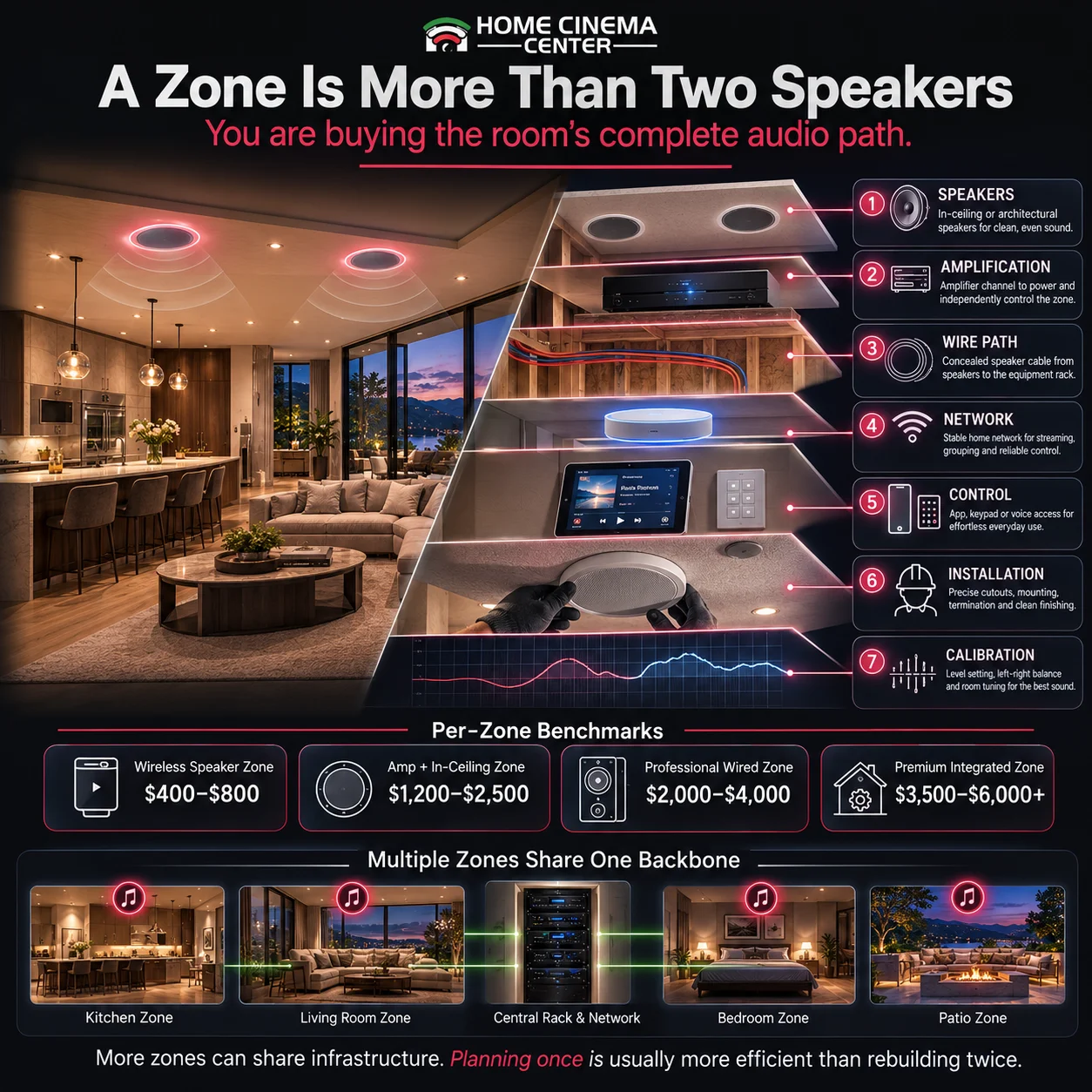
| Configuration | Approximate Cost Per Zone |
| Wireless Sonos speaker only | $400 – $800 per zone |
| Sonos Amp + in-ceiling speakers (wired) | $1,200 – $2,500 per zone |
| Full wired system, professional grade | $2,000 – $4,000 per zone |
| Premium with smart home integration | $3,500 – $6,000+ per zone |
These per-zone numbers decrease as the overall system grows running wire to eight rooms during a single project cost proportionally less per room than doing four rooms twice.
What Does Installation Labor Cost?
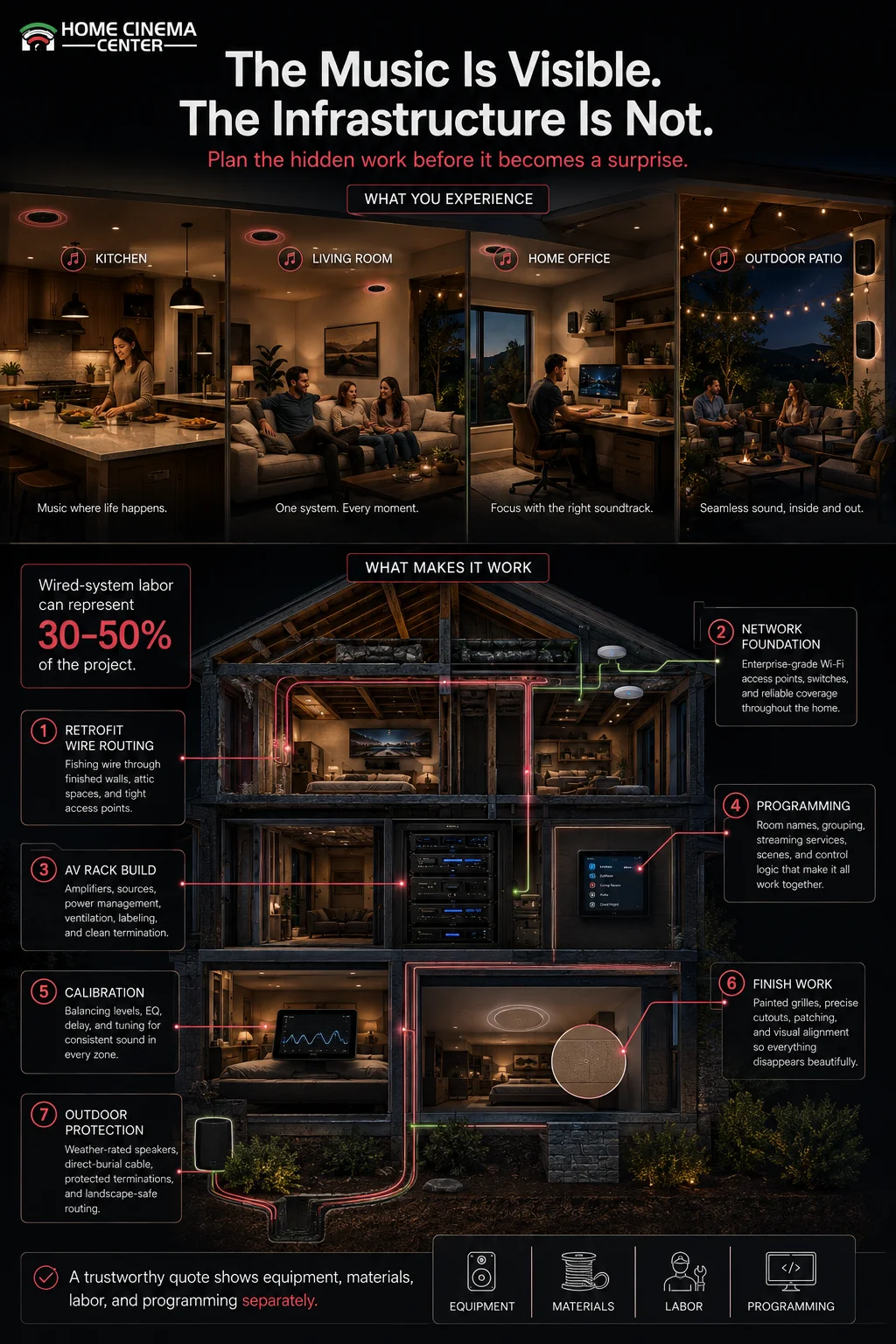
Labor is typically 30–50% of the total project cost for a wired installation. For a wireless Sonos setup, labor is a much smaller portion primarily network configuration and system programming.
What drives labor costs:
- Number of wires runs every room adds labor for cable routing through walls and ceilings
- Retrofit vs. new construction fishing wire through finished walls costs more than running wire during construction
- Ceiling material drywall is straightforward; plaster, tile, and concrete add time
- Rack build equipment rack assembly and wiring adds several hours of skilled labor
- System programming control system setup, EQ calibration, and smart home integration are billed as programming hours
A qualified installation team will provide a written quote that separates equipment, materials, and labor so you can see exactly where the budget is going.
Hidden Costs to Plan For
A few items that sometimes catch homeowners off guard:
Network upgrades. A wireless multi-room audio system needs a reliable, high-coverage Wi-Fi network. If the existing home network has dead zones or is older consumer equipment, upgrading it is often a prerequisite rather than an option. Home Cinema Marin’s home network design service addresses this as part of an integrated installation.
Conduit and rough-in work. If walls are already closed, getting wire from the equipment room to ceiling locations may require conduit runs in attic spaces, crawl spaces, or along baseboards. This is standard practice but adds time.
Painting speaker grilles. In-ceiling speaker grilles are typically painted to match the ceiling after installation. Professional painters charge separately for this if it’s not included in the installation scope.
Equipment room / AV rack. Multi-zone amplifiers, streaming sources, and control equipment need a dedicated space, a closet, an equipment rack, or a utility room. If that space doesn’t already exist, some minor construction may be needed.
Outdoor weatherproofing. Outdoor speaker zones require weather-rated speakers and, for any underground cable runs, direct burial-rated wire. These specifications cost more than standard indoor equivalents.
Is It Worth the Investment?
Homeowners who install whole-home audio systems consistently report it among their highest-use home technology investments. Unlike some smart home features that feel novel and then sit unused, music is something people engage with every day.
Beyond daily enjoyment, a professionally installed multi-room audio system adds real value to a home particularly in the Marin County and greater Bay Area market, where buyers expect integrated AV as part of a modern home. Homes with clean, professionally installed audio infrastructure (visible speakers, proper equipment rooms) present better and can support a higher sale price.
For both residential and commercial properties, the investment in clean, permanent audio infrastructure pays dividends in usability, aesthetics, and long-term property value.
How to Get an Accurate Quote
The most reliable way to understand what your specific installation will cost is a site consultation with a professional installer.
In that consultation, a qualified audio installer will:
- Walk the home and assess each proposed zone
- Evaluate wall and ceiling construction for wire routing
- Review the existing network infrastructure
- Identify any integration requirements with existing AV or smart home components
- Recommend specific equipment for each zone
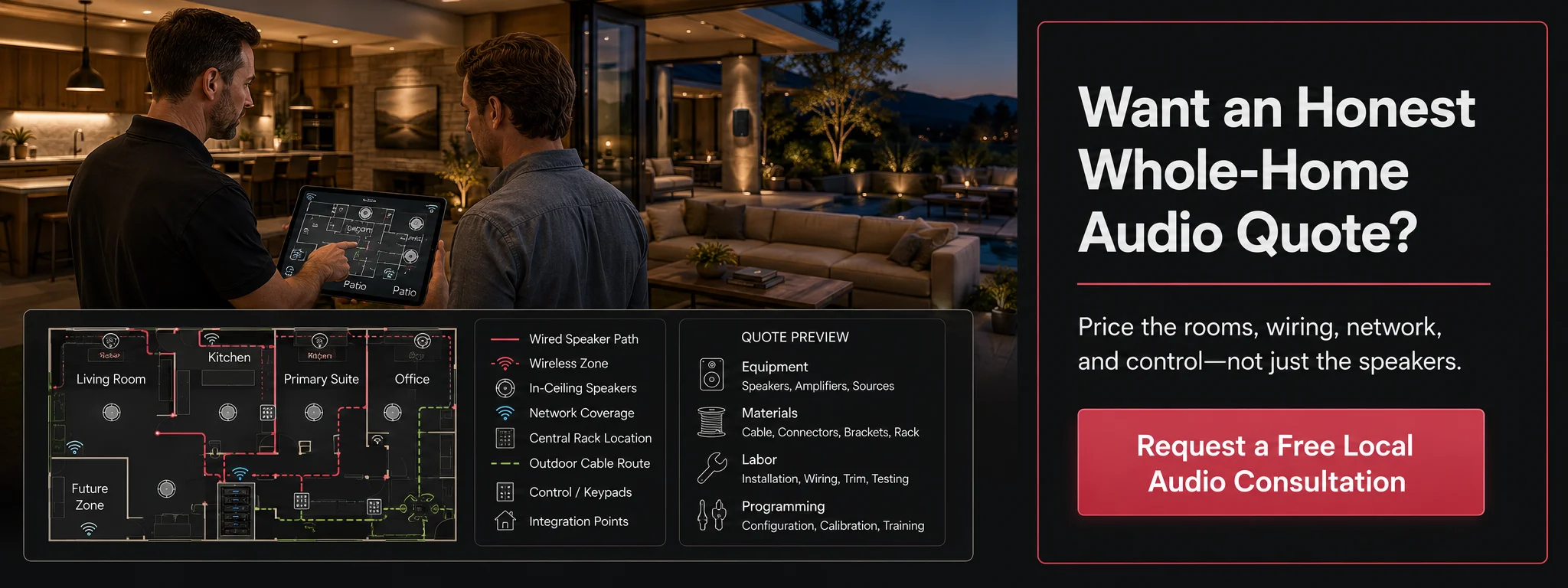
- Provide a detailed, itemized written quote
Home Cinema Marin provides free consultations for multi-room audio installation throughout Marin County, San Francisco, Sonoma, Napa, and surrounding areas. The quote covers equipment, materials, labor, and programming, no surprises.
Who provides multi-room audio installation in Marin County?
Home Cinema Marin installs multi-room audio systems throughout Marin County, San Francisco, Sonoma, Napa, and surrounding Bay Area communities. The team provides free site consultations and detailed written quotes. Call (415) 897-6217 or email info@homecinemamarin.com to schedule.
FAQs
How much does it cost to install a whole house audio system?
Whole house audio installation costs typically range from $1,500 for a basic wireless setup to $60,000+ for a premium multi-zone estate system with full smart home integration. For most primary residences with 4–8 zones, a professionally installed wired and wireless hybrid system runs $8,000–$20,000 depending on room count, speaker type, and control requirements.
Is whole home audio worth it?
For households that regularly listen to music which is most a whole home audio system, consistently ranks among the most-used home technology investments. It eliminates the compromises of Bluetooth speakers, fills the home with quality sound, and integrates with streaming services already in use. In the Bay Area market, it also supports home resale value.
What’s the cheapest way to get multi-room audio?
The lowest entry point is a wireless Sonos system of individual smart speakers placed in each room with no in-wall installation required. Two to three Sonos speakers can be set up for under $1,000 in equipment, with professional configuration available as an add-on. Sound quality is good, flexibility is high, and the system can be expanded over time.
How long does whole home audio installation take?
A basic 3–4 zone wireless setup can be installed and configured in a single day. A full wired system across 6–8 rooms with in-ceiling speakers and rack equipment typically takes 2–5 days depending on home size and construction. New construction installations where walls are open move faster than retrofits.
Can I add rooms to my audio system later?
Yes and a well-designed system makes this easier. If conduit or pre-wire runs were installed during the initial project, adding new zones later is straightforward. Even without pre-wiring, wireless Sonos zones can be added at any time with zero installation.
Does multi-room audio work with Alexa or Google?
Sonos integrates natively with both Amazon Alexa and Google Assistant. Voice commands work across all Sonos zones “Alexa, play jazz in the kitchen,” for example, works out of the box once accounts are linked. For whole home voice control including lighting and thermostats, Total Control by URC provides deeper integration.


