
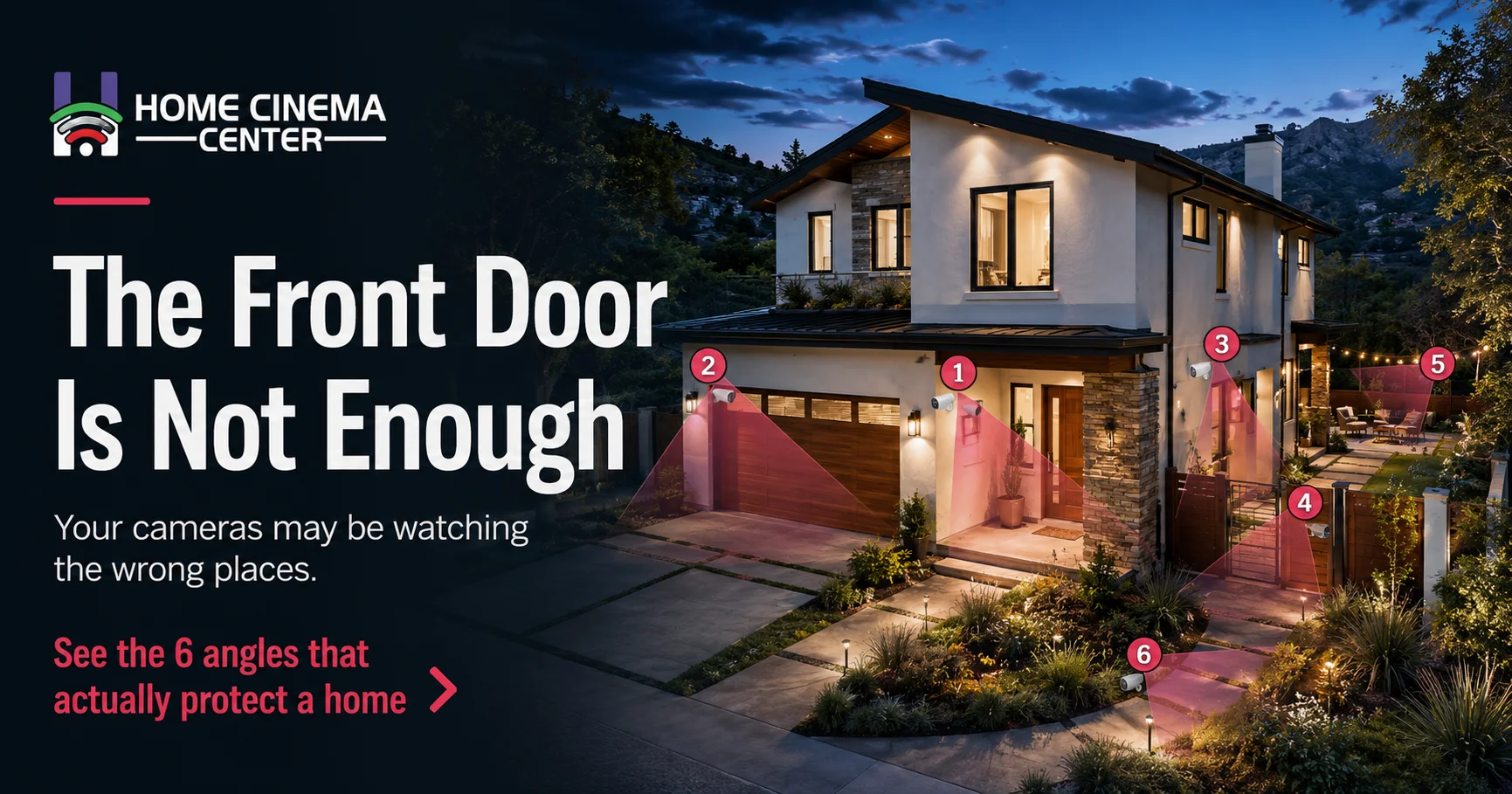
Your cameras may be looking at the wrong places.
That is usually the problem. Not the app. Not the camera brand. Not even the number of cameras. If the front door is covered but the side gate, driveway corner, back patio, or garage entry is invisible, the system may still miss the moment that matters.
For anyone wondering where to place security cameras around house, the goal is not to cover every inch. The goal is to cover the right angles: the places people actually approach, enter, park, deliver, hide, or pass through.
More cameras can still leave blind spots. Better placement closes them.
Key Takeaways
- The front door matters, but it is only one camera angle.
- Useful footage depends on placement, height, lighting, Wi-Fi, and recording setup.
- Side gates, garages, back doors, patios, and ground-floor access points are often missing.
- The best camera system is not the busiest one. It is the one that captures clear footage when it counts.

Quick Answer: Where Should Security Cameras Go Around a House?
The best places to put security cameras outside home are the front door and package zone, driveway and garage, back door, side gates, backyard or patio, and ground-floor windows or hidden approach paths. Cameras should be high enough to reduce tampering, angle low enough to capture faces, and placed where light, Wi-Fi, and privacy will not ruin the footage.
That is why home surveillance camera installation should begin with a property walkaround, not a random camera count.
A front door camera can help with visitors and packages. It cannot see the side yard. A driveway camera can watch vehicles. It may not see the garage side door. A backyard camera can cover the patio. It may still miss the gate.
Camera placement is a coverage puzzle. The wrong angle gives you a clip. The right angle gives you the story.

Why Camera Placement Fails
Most home security camera placement problems are simple, but easy to miss.
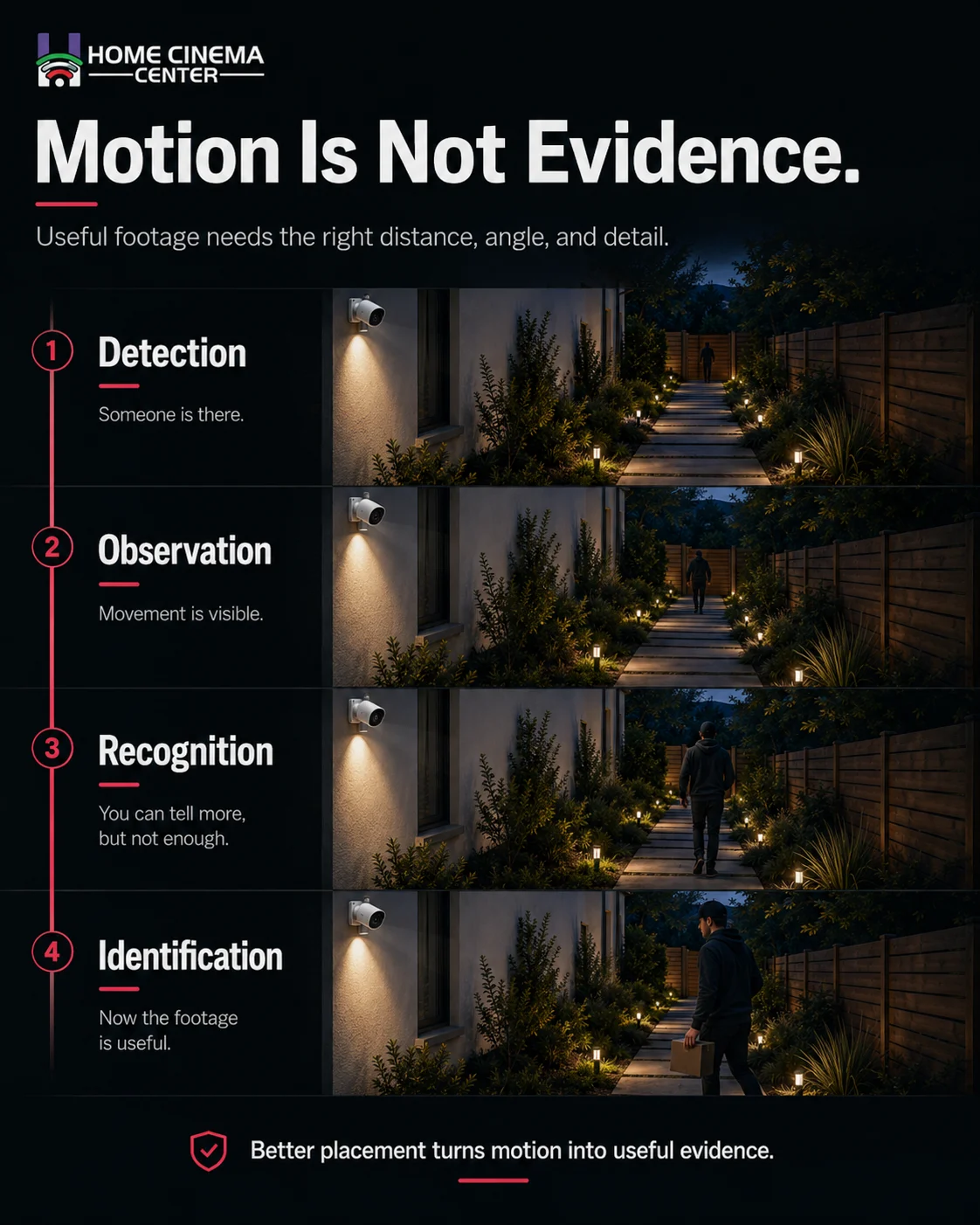
A camera is too high, so it records the top of someone’s head. A wide-angle camera sees the whole yard, but faces are too small to identify. A porch camera catches the package, but not the path someone takes to remove it. A side-yard camera points at a wall. A backyard camera works in daylight but turns into foggy blur at night.
That is how expensive security tech starts feeling cheap.
The hidden cause is often one of these:
- The camera sees motion but not detail.
- The camera catches the door but not the approach.
- The camera points too high or too wide.
- Trees, walls, lights, or reflections block the view.
- Night vision works poorly because of glare or weak lighting.
- Outdoor Wi-Fi drops the feed.
- Notifications become so noisy that people turn them off.
There is also a useful security concept called DORI: detection, observation, recognition, and identification. In simple terms, a camera can detect that someone is there, observe what they are doing, recognize a familiar person, or identify useful details. Those are different jobs. One camera angle may not do all of them well.
That is the first truth-teller moment: a camera can be working perfectly and still be placed badly.
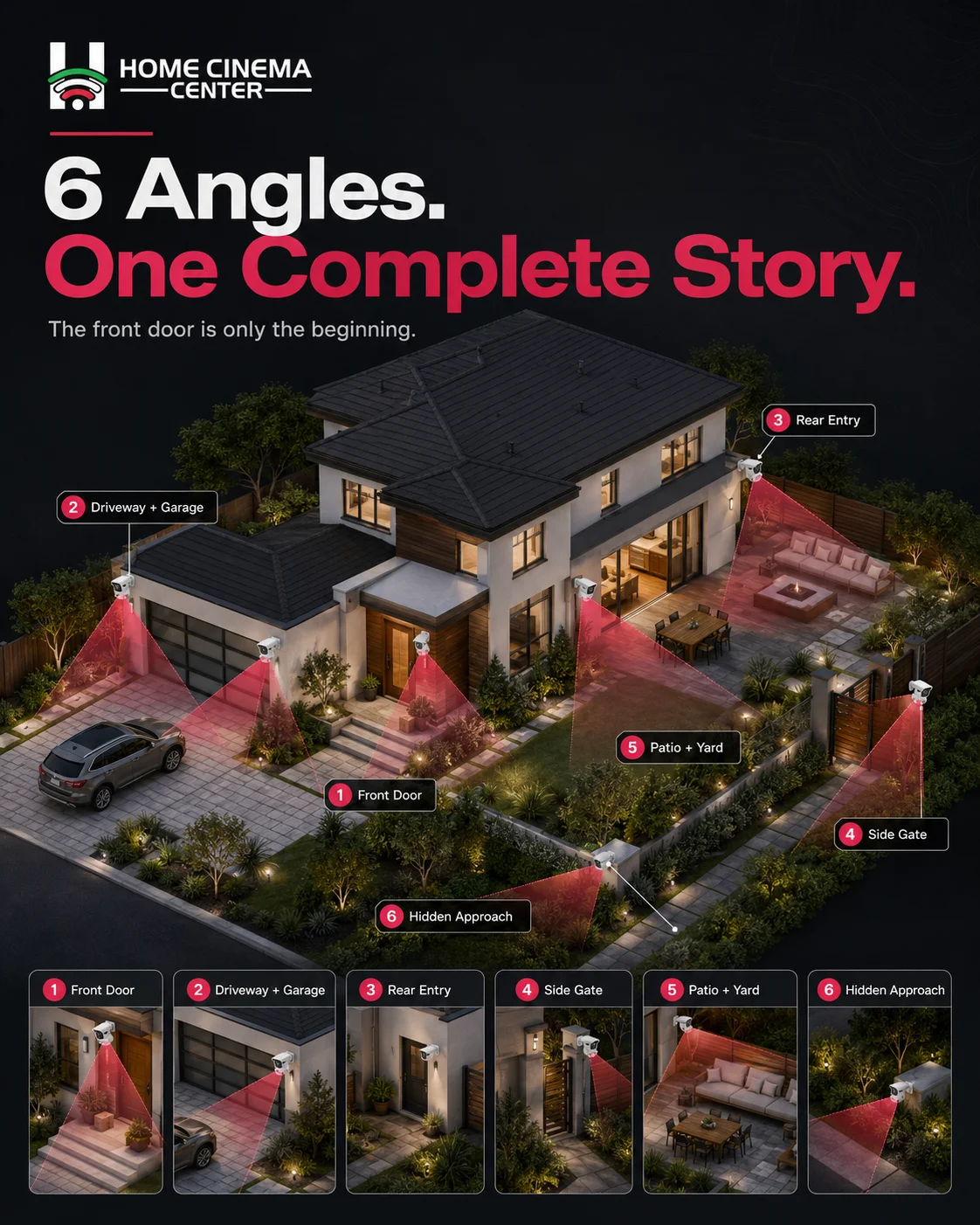
The 6 Camera Angles That Actually Protect a Home
1. Front Door and Package Zone
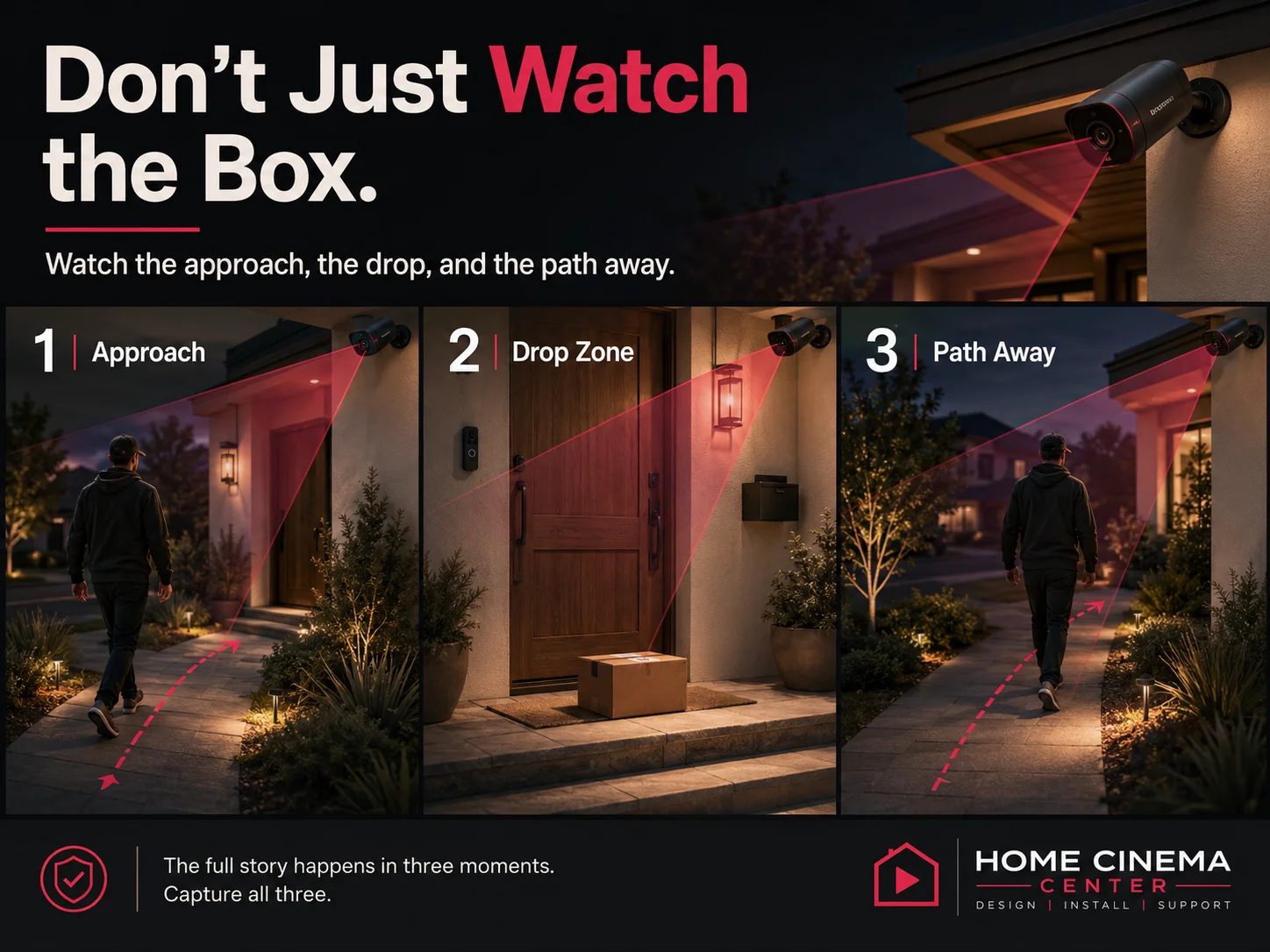
The front door is still the obvious starting point. It catches visitors, deliveries, service calls, and package activity.
But front door security camera placement should do more than show someone standing close to the lens. It should capture the approach, the face, the package drop area, and the path away from the porch.
A smart front door angle covers:
- The person’s face
- The walkway
- The package zone
- Porch steps
- The area where someone would turn and leave
For security camera placement for package theft, the camera should not only show the box. It should show what happens to the box. That difference matters.
2. Driveway and Garage

Driveway security camera placement is about arrivals, vehicles, garage doors, tools, bikes, and side movement.
The driveway is often the first place something happens, especially in homes with long approaches, detached garages, or outdoor storage. In Marin County, hillside homes and curved driveways can make this angle even more important.
A good driveway or garage camera should cover:
- Vehicles entering or leaving
- The garage door
- The path from driveway to house
- Any side garage entry
- Tools, bikes, or storage areas
Do not point the camera so wide that cars are visible but people are tiny. Wide coverage feels comforting until the footage needs to answer a real question.
For clean mounting and exterior wiring that does not make the property look patched together, residential and commercial AV installation can be part of the larger setup plan.
3. Back Door and Rear Entry
Back doors are often quieter than front doors. That is exactly why they need attention.
Sliding doors, patio doors, mudroom entries, and rear stairs may sit out of sight from the street. A camera pointed only at the door handle is too late. It should show the approach.
Check the rear entry for:
- Patio access
- Deck stairs
- Fence gates
- Outdoor furniture blocking views
- Shadows or low light
- Glass reflections at night
A back door camera should answer, “How did someone get there?” not only “Did someone reach the door?”
4. Side Gates and Side Yards

Side yards are the blind spot nobody brags about.
They are narrow. They are dark. They often have trash bins, utility doors, fences, or shrubs. They also connect the front of the property to the backyard without passing the front door camera.
This is where outdoor security camera placement becomes more than a checklist.
A side-yard camera should look down the path, not into the siding. It should cover the gate, the walkway, and the approach to the back of the house. If the camera has too wide a field of view, it may waste half the frame on fence boards and wall texture.
Side yards do not need drama. They need clean angles.
5. Backyard, Patio, and Outdoor Living Areas

Backyard security camera placement should protect more than patio furniture.
In Marin and Novato homes, outdoor living areas are often part of daily life: patios, grills, gates, pool areas, seating, paths, and storage. A backyard camera should respect privacy while still covering movement through the property.
Useful backyard angles may include:
- Back gate
- Patio door
- Fence line
- Outdoor storage
- Pool or play area, where appropriate
- Side path into the yard
A camera pointed only at the table misses the route. A camera pointed too far across the yard may lose detail. The sweet spot is the path people actually use.
6. Ground-Floor Windows and Hidden Approach Paths
Not every window needs a camera staring at it. Sometimes a window or door sensor is the better tool.
But the approach to ground-floor windows matters.
Look for lower-level windows hidden by shrubs, paths beside the house, basement entries, flat roof access, balcony access, or dark walkways. These areas may not look important during a quick walkaround, but they can be part of the real movement pattern around the property.
That is where to put security cameras for best coverage: not everywhere, but where the home has quiet access points.
The C.A.P.T.U.R.E. Placement Test

Before installing cameras, use this quick test. It keeps the layout practical and prevents expensive guesswork.
| Test Point | What to Check | Good Sign | Common Mistake |
| Coverage | Does the camera see the path and destination? | Approach and entry are visible | Camera sees only the door |
| Angle | Can the footage show useful detail? | Faces and actions are clear | Camera is too wide or too steep |
| Power | Can the camera stay online? | Wired, PoE, or planned power | Battery or outlet becomes a problem |
| Timing | Does it work at night? | Lighting and night vision are planned | Glare or darkness ruins footage |
| Upload | Is the network reliable? | Strong Wi-Fi or wired data | Camera drops offline |
| Recording | Is footage saved correctly? | Cloud or local storage is chosen | No clip when needed |
| Exposure | Is privacy respected? | Property-focused view | Neighbor privacy areas in frame |
This is the difference between installing cameras and designing coverage.
How High Should Security Cameras Be Mounted?
Security camera placement height should balance two needs: keep the camera hard to reach and keep the footage useful.
For many exterior mounted cameras, around 8 to 10 feet is a practical range when the location allows it. Lower than that may invite tampering. Much higher than that may capture hats, hair, and shoulders instead of faces.
A slight downward angle usually works better than pointing straight out or sharply down.
Use this simple rule:
If the camera cannot show a face, a path, or a useful action, the angle needs work.
Do not mount a camera under a roofline just because it is convenient. Convenient installation can create useless footage.
Wired vs Wireless Security Camera Placement
Wired vs wireless security camera placement is not only about convenience. It is about reliability.
Wireless cameras are easier to install, especially when running cable is difficult. They can work for simple front door or backyard coverage, but they depend on Wi-Fi signal, battery life or nearby power, and app-based recording.
Wired cameras, including PoE cameras, usually take more planning but can be better for long-term reliability. Power over Ethernet sends power and data through one cable, which makes it useful for multi-camera systems and exterior runs.
If cameras sit far from the router, behind thick walls, around stone, stucco, or metal, home network installation may matter as much as the cameras.
A camera that drops offline is not security. It is a decoration with a notification badge.

Where Not to Place Security Cameras
Bad locations can make good cameras look bad.
Avoid placing cameras:
- Behind windows with glare or night reflection
- Too high under a second-story roofline
- Too low on fences
- Facing direct sunrise or sunset
- Behind trees or shrubs that will grow into the shot
- Where half the frame is wall, sky, or pavement
- Too close to vents, heat, or moving branches
- Pointed into private neighbor areas
- Where night lighting causes glare
The Federal Trade Commission recommends securing home cameras by protecting the network, updating software, using strong passwords, and turning on available security features. Those steps matter because connected cameras need digital protection, not only good physical placement.
For network-connected devices, CISA also recommends regular software updates and removing unnecessary services or software.
Privacy, Audio, and California Homeowners
Security cameras should protect the home without creating new privacy problems.
Aim cameras at the homeowner’s property: doors, gates, driveway, yard, garage, package areas, and approach paths. Avoid pointing into neighbor windows, private yards, bathrooms, bedrooms, or shared spaces where people expect privacy.
Use privacy zones when the camera system allows it. Be careful with audio recording too. California Penal Code 632 addresses recording confidential communications without consent of all parties, so homeowners in California should be cautious and seek legal guidance when unsure.
This is not about fear. It is about responsible setup.
The FBI’s preliminary 2025 crime release reported that property crime decreased 12.4% from 2024 to 2025. That is good context, but it does not change the practical point: a camera system should be planned calmly, legally, and intelligently, not installed out of panic.
A Familiar Scenario: The Camera That Missed the Side Gate
Picture a Novato home with three cameras.
One watches the front door. One watches the garage. One watches the backyard patio.
It sounds covered.
Then someone walks through the side gate between the garage and fence. The front camera never sees them. The garage camera catches only the driveway. The backyard camera points at the seating area. Every camera works, but none of them explains how the person got there.
That is the quiet failure of poor placement.
The fix may not be adding five more cameras. It may be moving one camera, narrowing the field of view, adding a side-yard angle, improving lighting, or using a wired camera where Wi-Fi is weak.
Better coverage is often smarter than more coverage.
How Many Cameras Does a Home Need?
There is no universal number.
A small home may need only a few well-placed cameras. A larger Marin property with long driveways, patios, side gates, detached garages, hillside access, and finished walls may need more.
A useful starter map often looks like this:
- Front door and package zone
- Driveway and garage
- Back door or rear entry
- Side gate or side yard
- Backyard or patio
- Ground-floor window approach or hidden path
The final count depends on layout, not ego.
When DIY Is Enough and When to Call a Pro
DIY can work when the setup is simple: one or two cameras, strong Wi-Fi, easy power, clear views, and low privacy risk.
Professional planning becomes smarter when:
- Multiple exterior cameras are needed.
- The home has side gates, long driveways, or detached structures.
- Outdoor Wi-Fi is weak.
- PoE security camera installation is preferred.
- Clean wiring matters.
- Local storage security camera system planning is needed.
- Remote viewing must work reliably.
- Privacy zones need careful setup.
- Cameras should work with other smart home systems.
For homes where cameras, alerts, lighting, and control need to work together, Total Control smart home integration can make the system easier to use.
Good surveillance should not feel like homework. The hard thinking should happen before installation.
Final Takeaway
The front door is not enough.
Useful camera coverage follows the way people actually move around a home: front door, packages, driveway, garage, back door, side gates, patio, and hidden ground-floor paths. It also accounts for height, angle, lighting, Wi-Fi, recording, privacy, and clean wiring.
That is the real answer to where to place security cameras around house. Not more cameras. Better angles.
Want cameras that catch the moment that matters, not just empty footage? Visit Home Cinema Center or request a local consultation. Call 415 897 6217 or 415-892-5509, or email info@homecinemamarin.com.
FAQs
Where should I place security cameras around my house?
Place cameras at the front door, driveway, garage, back door, side gate, backyard or patio, and hidden ground-floor access paths. Focus on approach routes, not just doors.
What are the best places to put security cameras outside home?
The best outdoor spots are package zones, driveway, garage, back door, side yard, backyard gate, and patio area. These cover common movement paths without adding random cameras.
How many security cameras do I need for my house?
It depends on layout. A simple home may need a few cameras, while larger homes with long driveways, side gates, detached garages, or patios may need more.
What height should security cameras be mounted?
Many exterior cameras work well around 8 to 10 feet high when possible. The camera should be hard to reach but low enough to capture faces and useful details.
Where should security cameras not be placed?
Avoid placing cameras behind windows, too high under rooflines, facing direct sun, blocked by trees, pointed at neighbor privacy areas, or where night glare will ruin footage.
Should cameras face doors or windows?
Cameras should usually cover doors and approach paths first. For windows, sensors may sometimes be better than pointing cameras directly at glass or private interior areas.
Do outdoor cameras need lighting at night?
Outdoor cameras need either strong night vision or helpful lighting. Motion lights, infrared night vision, and smart placement can make nighttime footage clearer.
Are wired cameras better than wireless cameras outside?
Wired cameras, especially PoE cameras, are often more reliable for long-term outdoor systems. Wireless cameras are easier to install, but they depend on Wi-Fi and battery or power access.
Can the Novato team help with home and business camera layouts?
Yes. The team can plan camera angles, wiring, network support, recording, remote viewing, and clean exterior installation for residential and commercial spaces.
Can the local showroom team help avoid blind spots before installation?
Yes. A property layout review can identify side gates, back entries, garage areas, patios, and hidden access paths before cameras are mounted.


